
Ask Figaro
Got a question about rhetoric, figures, Figaro, Figaro's book,the nature of the universe, or just want to lavish praise?
Write in the form at the bottom of this page.
Dear Figaro,
As the matter of fact I am writing a paper, though Jefferson is just a part of it. That is among figures of speech found in other presidetial addresses. I did not have any problems identifying figures of speech in modern addresses (Obama's, Clinton's etc) but the Jefferson's address is a kind of issue. :) I managed to find some obvious ones - anaphora, antithesis, alliteration, metaphors for example - but not the 'subtle ones'. I do not know if that is a valid exuce but Being a student from Slovenia, it is kind of difficult to understand the language of Jefferson with all the complex sentences, appositions and so on.
Thank you for understanding.
I appreciate your effort. Nataly
Dear Nataly,
Would that Americans were working so hard on American rhetoric! I don't blame you for finding Jefferson hard to parse, figuratively. While I can't help you write the paper, go to Wordhero.org for a good description of figures, then see how many you can match to the speech.
For example, "anxious and awful presentiments." That's alliteration, isn't it? "The greatness of the charge and the weakness of my powers..." a figure of contrast, no? What would you call "steer with safety the vessel"?
You'll find two or three devices in each Jeffersonian sentence. Take them one phrase or clause at a time, and don't drown in the endless sentences!
Fig.
As the matter of fact I am writing a paper, though Jefferson is just a part of it. That is among figures of speech found in other presidetial addresses. I did not have any problems identifying figures of speech in modern addresses (Obama's, Clinton's etc) but the Jefferson's address is a kind of issue. :) I managed to find some obvious ones - anaphora, antithesis, alliteration, metaphors for example - but not the 'subtle ones'. I do not know if that is a valid exuce but Being a student from Slovenia, it is kind of difficult to understand the language of Jefferson with all the complex sentences, appositions and so on.
Thank you for understanding.
I appreciate your effort. Nataly
Dear Nataly,
Would that Americans were working so hard on American rhetoric! I don't blame you for finding Jefferson hard to parse, figuratively. While I can't help you write the paper, go to Wordhero.org for a good description of figures, then see how many you can match to the speech.
For example, "anxious and awful presentiments." That's alliteration, isn't it? "The greatness of the charge and the weakness of my powers..." a figure of contrast, no? What would you call "steer with safety the vessel"?
You'll find two or three devices in each Jeffersonian sentence. Take them one phrase or clause at a time, and don't drown in the endless sentences!
Fig.
July 26, 2011 |
 Nataly
Nataly
Hi Figaro, can you please tell me what is the figurative language being portrayed in the sentance?
"I climbed up the door and opened the stairs."
Thank you.
Peterni
Dear Pete,
Ah, the Spoonerism! Named for the eponymous and malaproptastic Oxford dean, William Archibald Spooner, the Spoonerism reverses thoughts or word sounds, usually by accident. "You have tasted a whole worm," the reverend Spooner is said to have lectured a truant student. "Please leave Oxford on the next town drain."
Most linguists limit the Spoonerism to word sounds; but Figaro believes that the switching extends to concepts as well. The roar of the greasepaint, the smell of the crowd. Spooner himself couldn't do better.
Fig.
"I climbed up the door and opened the stairs."
Thank you.
Peterni
Dear Pete,
Ah, the Spoonerism! Named for the eponymous and malaproptastic Oxford dean, William Archibald Spooner, the Spoonerism reverses thoughts or word sounds, usually by accident. "You have tasted a whole worm," the reverend Spooner is said to have lectured a truant student. "Please leave Oxford on the next town drain."
Most linguists limit the Spoonerism to word sounds; but Figaro believes that the switching extends to concepts as well. The roar of the greasepaint, the smell of the crowd. Spooner himself couldn't do better.
Fig.
July 16, 2011 |
Peterni
Peterni
Dear Figaro,
would you be so kind and tell me what figures of speech can you identify in Thomas Jefferson's First Inaugural address?
Nataly
Dear Nataly,
Are we, perhaps, writing a paper?
Fig.
would you be so kind and tell me what figures of speech can you identify in Thomas Jefferson's First Inaugural address?
Nataly
Dear Nataly,
Are we, perhaps, writing a paper?
Fig.
July 16, 2011 |
Nataly
Nataly
Figaro,
In you section of 10 ways to use figures, you listed dilemma as a way to control am issue. How would you use a dilemma that way? Is it to demonstrate your opponent's assertion leads to nowhere productive? Is it a way to show how there wasn't anything you could have done in a situation because you had a no win situation?
In you section of 10 ways to use figures, you listed dilemma as a way to control am issue. How would you use a dilemma that way? Is it to demonstrate your opponent's assertion leads to nowhere productive? Is it a way to show how there wasn't anything you could have done in a situation because you had a no win situation?
July 1, 2011 |
ALR
ALR
Dear Figaro,
One Greek Mr. X says, "All Cretans are liars." X himself is from Crete.
Q: Is this a literary figure?
What is the solution to this 'problem'?
Christian
Dear Christian,
Ah, the old Epimenides paradox! Epimenides, a Cretan, wrote these famous words about 2,600 years ago in a poem about Zeus. Philosophers call it a "self-referential paradox," because the paradox arises from the speaker himself. Therefore it's technically not an autophasia, or Catch-22 but a plain old philosophical conundrum.
The solution? Stay away from Crete. Besides being allegedly full of liars, we hear the economy is terrible.
Fig.
One Greek Mr. X says, "All Cretans are liars." X himself is from Crete.
Q: Is this a literary figure?
What is the solution to this 'problem'?
Christian
Dear Christian,
Ah, the old Epimenides paradox! Epimenides, a Cretan, wrote these famous words about 2,600 years ago in a poem about Zeus. Philosophers call it a "self-referential paradox," because the paradox arises from the speaker himself. Therefore it's technically not an autophasia, or Catch-22 but a plain old philosophical conundrum.
The solution? Stay away from Crete. Besides being allegedly full of liars, we hear the economy is terrible.
Fig.
June 8, 2011 |
Christian
Christian
Figaro;
On the subject of Conservatives being good at labelling, I'm not sure I understand how labels work. Can you comment on my following attempts at labeling.
1. Government through the highest Bidder
2. Big business owned Government
3. Industry welfare {i think this was already done}
4. Pro industry propaganda
AiR
Dear AiRman,
You're getting there. "Government of the highest bidder" has been out there for a while. I'm not particularly fond of it, because it's not concrete enough. You want to conjure a single person or caricature--a particular crooked fatcat everybody loves to hate. Who would that be? Or do we love all rich people (go, Trump!) these days?
"Big-business owned government" similarly isn't specific enough. Ditto with "pro-industry propaganda."
Learn your Belonging Tropes; you'll find them explained on my new site, Wordhero.org. That's where the best labels lie.
Label on!
Fig.
On the subject of Conservatives being good at labelling, I'm not sure I understand how labels work. Can you comment on my following attempts at labeling.
1. Government through the highest Bidder
2. Big business owned Government
3. Industry welfare {i think this was already done}
4. Pro industry propaganda
AiR
Dear AiRman,
You're getting there. "Government of the highest bidder" has been out there for a while. I'm not particularly fond of it, because it's not concrete enough. You want to conjure a single person or caricature--a particular crooked fatcat everybody loves to hate. Who would that be? Or do we love all rich people (go, Trump!) these days?
"Big-business owned government" similarly isn't specific enough. Ditto with "pro-industry propaganda."
Learn your Belonging Tropes; you'll find them explained on my new site, Wordhero.org. That's where the best labels lie.
Label on!
Fig.
May 10, 2011 |
AiR
AiR
Fig,
I just finished Thank You for Arguing. I enjoyed it and have pre-ordered your next book.
Here’s my question or situation:
I’m a junior manager; my boss often attempts to belittle me during meetings with upper management. Here are two examples:
Example 1
Condescending Boss is presenting a proposal with upper management present; I’m following along with my copy. Condescending Boss suddenly stops and says to me, “I can see you don’t understand, but don’t interrupt me until I’m finished and then I’ll answer your questions.” (I had no intentions of interrupting, nor did I have a question.) I felt like any response on my part would appear petty or unprofessional.
Example 2
Condescending Boss informs me in a private email that he will complete XYZ, one of our shared responsibilities, while I’m out of state working on another project. When I return two weeks later, he says (in front of upper management), “You need to take care of XYZ –it’s been sitting here since you left.” Again, how can I respond in the presence of upper management without appearing insubordinate or petty?
Thanks in advance for your rhetorical guidance,
Jim
Dear Jim,
My first move would be to update my resume. A scornful boss is an unending misery.
Still, you show good instincts in wanting to play to a different audience: specifically, Mr. X's superiors. Your second example gives you the opportunity to act innocent: "You've been pretty busy, huh? I'll jump right on it." One of the best ways to handle a cynical opponent is to ironically assume pure motives on his part. Your superiors will probably see right through it. If he says, "What do you mean? This is your project," then you reply, "Then we had a disconnect. I understood that you were going to finish it while I was doing the XYZ job. No worries, I'll handle it."
In your first example, I'm assuming that the boss is the senior person in the meeting. The safest bet is to smile and say nothing. But if you want to get some respect from colleagues, say, "You're quite the mind reader." Now, polish that resume--fast.
Fig.
I just finished Thank You for Arguing. I enjoyed it and have pre-ordered your next book.
Here’s my question or situation:
I’m a junior manager; my boss often attempts to belittle me during meetings with upper management. Here are two examples:
Example 1
Condescending Boss is presenting a proposal with upper management present; I’m following along with my copy. Condescending Boss suddenly stops and says to me, “I can see you don’t understand, but don’t interrupt me until I’m finished and then I’ll answer your questions.” (I had no intentions of interrupting, nor did I have a question.) I felt like any response on my part would appear petty or unprofessional.
Example 2
Condescending Boss informs me in a private email that he will complete XYZ, one of our shared responsibilities, while I’m out of state working on another project. When I return two weeks later, he says (in front of upper management), “You need to take care of XYZ –it’s been sitting here since you left.” Again, how can I respond in the presence of upper management without appearing insubordinate or petty?
Thanks in advance for your rhetorical guidance,
Jim
Dear Jim,
My first move would be to update my resume. A scornful boss is an unending misery.
Still, you show good instincts in wanting to play to a different audience: specifically, Mr. X's superiors. Your second example gives you the opportunity to act innocent: "You've been pretty busy, huh? I'll jump right on it." One of the best ways to handle a cynical opponent is to ironically assume pure motives on his part. Your superiors will probably see right through it. If he says, "What do you mean? This is your project," then you reply, "Then we had a disconnect. I understood that you were going to finish it while I was doing the XYZ job. No worries, I'll handle it."
In your first example, I'm assuming that the boss is the senior person in the meeting. The safest bet is to smile and say nothing. But if you want to get some respect from colleagues, say, "You're quite the mind reader." Now, polish that resume--fast.
Fig.
April 27, 2011 |
JIm
JIm
Dear Figaro,
Is there a figure of speech that describes the deliberate use of "ain't" or other nonstandard or nongrammatical words or forms? The use of "ain't" certainly has a noticeable rhetorical effect.
Many thanks for the entertainment and education!
Yours,
Candace
Dear Candace,
As far as I know, the ancients didn't have a name for affected speech that brings the speaker to the level of the hoi polloi; most orators back then were trying to sound upper-class. When you try to sound fancy and blow it ("He invited him and I to the party"), that's a kind of cacozelia. Saying "ain't" is the opposite.
I call the affect use of words like "folks" (you listening, President Obama?) and "ain't" FOLKISTRY. It's sophistry for the folk. And I ain't lying.
Fig.
Is there a figure of speech that describes the deliberate use of "ain't" or other nonstandard or nongrammatical words or forms? The use of "ain't" certainly has a noticeable rhetorical effect.
Many thanks for the entertainment and education!
Yours,
Candace
Dear Candace,
As far as I know, the ancients didn't have a name for affected speech that brings the speaker to the level of the hoi polloi; most orators back then were trying to sound upper-class. When you try to sound fancy and blow it ("He invited him and I to the party"), that's a kind of cacozelia. Saying "ain't" is the opposite.
I call the affect use of words like "folks" (you listening, President Obama?) and "ain't" FOLKISTRY. It's sophistry for the folk. And I ain't lying.
Fig.
April 7, 2011 |
Candace
Candace
Dear Figaro,
I just recently discovered you had a blog after you mentioned it in your book.
I'd love to see you on Twitter, perhaps it could change your idea on the Internet & the way it's helping shape modern day democracy.
Best Regards,
Ahmad
Dear Ahmad,
I plan to use Twitter to help promote Word Hero, but won't want to do much following on it. The Internet has many tools--Twitter and other social networking among them--and Figaro uses him in his consulting work. But Twitter in particular has its limitations. It's a medium of ethos, or identity--not good for conveying logical thoughts but excellent for bringing groups together and making them feel united. Revolutions depend on this kind of identity.
But we're mistaken in thinking that technology changes human character. If it did, Aristotle wouldn't make any sense at all. And when it comes to rhetoric, Aristotle is the man. We humans haven't changed much in the past few millennium.
Fig.
I just recently discovered you had a blog after you mentioned it in your book.
I'd love to see you on Twitter, perhaps it could change your idea on the Internet & the way it's helping shape modern day democracy.
Best Regards,
Ahmad
Dear Ahmad,
I plan to use Twitter to help promote Word Hero, but won't want to do much following on it. The Internet has many tools--Twitter and other social networking among them--and Figaro uses him in his consulting work. But Twitter in particular has its limitations. It's a medium of ethos, or identity--not good for conveying logical thoughts but excellent for bringing groups together and making them feel united. Revolutions depend on this kind of identity.
But we're mistaken in thinking that technology changes human character. If it did, Aristotle wouldn't make any sense at all. And when it comes to rhetoric, Aristotle is the man. We humans haven't changed much in the past few millennium.
Fig.
March 21, 2011 |
Ahmad F. Al-Shagra
Ahmad F. Al-Shagra
Dear Figaro,
Just wanted to give you an argument my Mom told me when I was about 14 or so (I'm now 52)....Seattle Times headline below the fold, front page: "SeaFirst Bank only gives 16.7% of its loans to Black people".
Mom, very VERRRRY liberal, wanted me, of course, to believe that this was proof that black people were being railroaded and shoved into a back of the bus life and I said (astounded that she couldn't see the error in the headline) "Mom, what's the % of black people in the Seattle area?"....naturally, she couldn't understand why this had any bearing at all on the issue and said "how the hell should I know"....and the census had just come out a few weeks prior, oddly enough, the %'s of racial groups had been published in, none other than.....the Seattle Times and I said "less than 9.5% Mom"....she said "so?" and then I explained to her that knowing that black people as a group tend to have lower credit ratings than whites (whites typically have still lower credit ratings than Asians), that blacks were being treated exponentially better in the credit department than all other classes of borrowers because the banks were scared shitless to be cornered by the head banking dudes in DC saying...."why are you treating blacks so poorly?".
It took me about a half hour but eventually she could see that the purpose of the headline was to elicit exactly the response she had given, that whites and asians by virtue were the downtrodden class in this instance and that the reporter had simply not done their homework in any way shape or form....and that their "facts" were in fact.....not at all.
Jon
Just wanted to give you an argument my Mom told me when I was about 14 or so (I'm now 52)....Seattle Times headline below the fold, front page: "SeaFirst Bank only gives 16.7% of its loans to Black people".
Mom, very VERRRRY liberal, wanted me, of course, to believe that this was proof that black people were being railroaded and shoved into a back of the bus life and I said (astounded that she couldn't see the error in the headline) "Mom, what's the % of black people in the Seattle area?"....naturally, she couldn't understand why this had any bearing at all on the issue and said "how the hell should I know"....and the census had just come out a few weeks prior, oddly enough, the %'s of racial groups had been published in, none other than.....the Seattle Times and I said "less than 9.5% Mom"....she said "so?" and then I explained to her that knowing that black people as a group tend to have lower credit ratings than whites (whites typically have still lower credit ratings than Asians), that blacks were being treated exponentially better in the credit department than all other classes of borrowers because the banks were scared shitless to be cornered by the head banking dudes in DC saying...."why are you treating blacks so poorly?".
It took me about a half hour but eventually she could see that the purpose of the headline was to elicit exactly the response she had given, that whites and asians by virtue were the downtrodden class in this instance and that the reporter had simply not done their homework in any way shape or form....and that their "facts" were in fact.....not at all.
Jon
March 21, 2011 |
Jon
Jon
Dear Figaro,
Are you familiar with the Columbo Technique, being put forward by Greg Koukl? What do you thing of it's effectiveness?
TC
Dear TC,
Koukl's "Columbo Tactic," as he describes it on his site, Stand to Reason (www.str.org), asks questions for tactical reasons to reveal flaws in an opponent's argument. We'd qualify it as a form of APORIA, the tactic of feigning ignorance. (Use the search box on the right if you want to see examples of aporia.)
While the the rhetorical question that doesn't look rhetorical makes for a good logical technique, we're not sure we like the Columbo label. The TV Columbo's big technique wasn't the leading question (what detective doesn't ask leading questions?). It was the last-second question, after his victim thinks the interview is over. "Oh, I almost forgot..."
Columbo's real rhetorical technique was KAIROS, the art of timing.
Fig.
Are you familiar with the Columbo Technique, being put forward by Greg Koukl? What do you thing of it's effectiveness?
TC
Dear TC,
Koukl's "Columbo Tactic," as he describes it on his site, Stand to Reason (www.str.org), asks questions for tactical reasons to reveal flaws in an opponent's argument. We'd qualify it as a form of APORIA, the tactic of feigning ignorance. (Use the search box on the right if you want to see examples of aporia.)
While the the rhetorical question that doesn't look rhetorical makes for a good logical technique, we're not sure we like the Columbo label. The TV Columbo's big technique wasn't the leading question (what detective doesn't ask leading questions?). It was the last-second question, after his victim thinks the interview is over. "Oh, I almost forgot..."
Columbo's real rhetorical technique was KAIROS, the art of timing.
Fig.
March 21, 2011 |
TC
TC
Dear Figaro
I would like to ask about figure of speech and figurative language. Are they the same? or different? I need the answer so badly. Also, can you give me an article or book that write about it?
Thank you so much.
Rusdi
Dear Rusdi,
Figurative language comprises the unusual order of words, or the use of unusual words. Figures of speech are words arranged in striking ways. So figures fall under figurative language. But so do tropes--non-literal language. If none of this makes sense to you, browse this site.
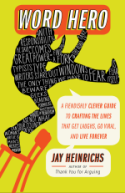
In the "Best Books" section (see the top of this page), you'll find a great guide to figures. If you can wait till October, you can buy my next book, Word Hero. It's all about figurative language, and how to use it to make a memorable sentence.
Fig.
I would like to ask about figure of speech and figurative language. Are they the same? or different? I need the answer so badly. Also, can you give me an article or book that write about it?
Thank you so much.
Rusdi
Dear Rusdi,
Figurative language comprises the unusual order of words, or the use of unusual words. Figures of speech are words arranged in striking ways. So figures fall under figurative language. But so do tropes--non-literal language. If none of this makes sense to you, browse this site.
In the "Best Books" section (see the top of this page), you'll find a great guide to figures. If you can wait till October, you can buy my next book, Word Hero. It's all about figurative language, and how to use it to make a memorable sentence.
Fig.
March 12, 2011 |
Rusdi Manaf
Rusdi Manaf
Dear Figaro,
At work we have a daily morning huddle/ meeting (its as bad as it sounds) There is always some frission between the manager and one of our caseworkers. She has a really annoying of pretending to find something funny as a way of undermining what the manager says. Its really patronising. What is this called? I cannot verbalise why its so annoying. And no I'm not the manager :o)
Geoff
Dear Geoff,
We would call that annoying trait "belittlement"--the rhetorical act of making someone seem smaller. What's more belittling than laughing at someone, after all?
Aristotle said that belittlement is the chief cause of anger, particularly among young men. What's the cure? Encourage the case worker to reply, with smile, "I wasn't trying to be funny, but I admire your ability to find humor everywhere." Yeah, that's belittling as well. But duller minds won't notice.
Fig.
At work we have a daily morning huddle/ meeting (its as bad as it sounds) There is always some frission between the manager and one of our caseworkers. She has a really annoying of pretending to find something funny as a way of undermining what the manager says. Its really patronising. What is this called? I cannot verbalise why its so annoying. And no I'm not the manager :o)
Geoff
Dear Geoff,
We would call that annoying trait "belittlement"--the rhetorical act of making someone seem smaller. What's more belittling than laughing at someone, after all?
Aristotle said that belittlement is the chief cause of anger, particularly among young men. What's the cure? Encourage the case worker to reply, with smile, "I wasn't trying to be funny, but I admire your ability to find humor everywhere." Yeah, that's belittling as well. But duller minds won't notice.
Fig.
February 28, 2011 |
Geoff
Geoff
Dear Figaro,
I just finished reading "Thank You For Arguing" and wanted to thank you for writing such an amazing book. I borrowed it from the library, but it's so useful that I just ordered a copy from Amazon. Thank you!
Chris
Dear Chris,
It's people like you who keep my figurative world spinning round. Many thanks.
Fig.
I just finished reading "Thank You For Arguing" and wanted to thank you for writing such an amazing book. I borrowed it from the library, but it's so useful that I just ordered a copy from Amazon. Thank you!
Chris
Dear Chris,
It's people like you who keep my figurative world spinning round. Many thanks.
Fig.
February 12, 2011 |
Chris
Chris
Dear Fig,
I'm not sure if this is a figure of speech or a larger team-rhetoric strategy, but is there a term for the technique of having one rhetor make intentionally-extremist proclamations in order to push the bounds of normality, and in so doing make the slightly-less-extremist people in his own tribe sound more reasonable?
It's sort of the "bad cop, slightly-less-bad cop" version of discourse, and is only effective when you have more than one person arguing the same side of a debate.
I see it a lot in the national discourse, and I get the feeling it's an intentional strategy, but I'd like to know if there's a name for it.
Dear Steve,
While I don't know of any technical term for it (feel free to supply one, rhetoricians), in my next book I describe the technique as a Contraster, a figure of relativity that uses contrasts to make things look better or worse, bigger or smaller. Spiro Agnew, the maniacal vice president under Richard Nixon, helped make Nixon look like a moderate. A neat Contraster.
As a figure of speech, the Contraster lets you bring in objects to change the perspective on a subject. Look what happens in the classic 1950 film Sunset Boulevard.
Joe: You're Norma Desmond. You used to be in silent pictures. You used to be big.
Norma: I am big. It's the pictures that got small.
In just two lines you get the theme of the movie: has-been film prima donna lamenting a Golden Age of moving pictures.
Fig.
Thanks,
Steve B
I'm not sure if this is a figure of speech or a larger team-rhetoric strategy, but is there a term for the technique of having one rhetor make intentionally-extremist proclamations in order to push the bounds of normality, and in so doing make the slightly-less-extremist people in his own tribe sound more reasonable?
It's sort of the "bad cop, slightly-less-bad cop" version of discourse, and is only effective when you have more than one person arguing the same side of a debate.
I see it a lot in the national discourse, and I get the feeling it's an intentional strategy, but I'd like to know if there's a name for it.
Dear Steve,
While I don't know of any technical term for it (feel free to supply one, rhetoricians), in my next book I describe the technique as a Contraster, a figure of relativity that uses contrasts to make things look better or worse, bigger or smaller. Spiro Agnew, the maniacal vice president under Richard Nixon, helped make Nixon look like a moderate. A neat Contraster.
As a figure of speech, the Contraster lets you bring in objects to change the perspective on a subject. Look what happens in the classic 1950 film Sunset Boulevard.
Joe: You're Norma Desmond. You used to be in silent pictures. You used to be big.
Norma: I am big. It's the pictures that got small.
In just two lines you get the theme of the movie: has-been film prima donna lamenting a Golden Age of moving pictures.
Fig.
Thanks,
Steve B
February 4, 2011 |
Steve B
Steve B
Hey Fig,
I'm going on 25 actually ;). I'll do some review reading of your book and keep you posted!
Thanks!!
-Mary
I'm going on 25 actually ;). I'll do some review reading of your book and keep you posted!
Thanks!!
-Mary
January 17, 2011 |
Mary
Mary
Hi Figaro,
Where can I practice being persuasive? Can you suggest some places I can practice honing my skills without losing friends or making my parents angry?
Thanks!
-Mary
Dear Mary,
Good question! The answer depends how old you are. Do you have a debating team? While school debate practices only a few argument skills, it's a great start. At the same time, think about ways to disagree with your friends without making them angry. How can you express your disagreement in ways that make it sound like you're agreeing? Or that remind them of things you know they believe in?
In my book, I talk about the need to understand your audience before you can persuade them. What do your parents believe and expect?
I know, this is hard. And once you do know your audience, sometimes it's hard to even bring up a disagreement. Parents tend to say "Because I told you to!" when you ask for an explanation. But keep this in mind: Every "No," every angry outburst, is a kind of information. Ask yourself what's causing it. And then work with that. If your parents think that an "obedient" child is one who always agrees with them, then always agree. Then use another moment, when things calm down, to talk about what you think is important.
When you get a chance, come back to the site and tell me more about arguing with your parents and friends. Then let's see what we can work out.
Fig.
Where can I practice being persuasive? Can you suggest some places I can practice honing my skills without losing friends or making my parents angry?
Thanks!
-Mary
Dear Mary,
Good question! The answer depends how old you are. Do you have a debating team? While school debate practices only a few argument skills, it's a great start. At the same time, think about ways to disagree with your friends without making them angry. How can you express your disagreement in ways that make it sound like you're agreeing? Or that remind them of things you know they believe in?
In my book, I talk about the need to understand your audience before you can persuade them. What do your parents believe and expect?
I know, this is hard. And once you do know your audience, sometimes it's hard to even bring up a disagreement. Parents tend to say "Because I told you to!" when you ask for an explanation. But keep this in mind: Every "No," every angry outburst, is a kind of information. Ask yourself what's causing it. And then work with that. If your parents think that an "obedient" child is one who always agrees with them, then always agree. Then use another moment, when things calm down, to talk about what you think is important.
When you get a chance, come back to the site and tell me more about arguing with your parents and friends. Then let's see what we can work out.
Fig.
January 12, 2011 |
Mary
Mary
Dear Figaro,
Someone sought unsuccessfully to inveigle a wary friend into joining his side of a power struggle among managers of an organisation for which my friend does a lot of consulting work, with a device which I am trying to analyse rhetorically, but cannot to my full satisfaction.
Actually I had hoped when my friend recounted his story to be able to put my finger on what had been practised on him by exclaiming magisterially, "Oh, but that is a textbook example of [ziziereia]!" But I am stumped and I am hoping you may offer some insights.
The "player" had invited my friend to dinner and in this setting sought to involve him in some gambit to reduce the influence of one of the other players. He imparted certain information, but before doing so said something like,
Player: "Well are you aware that .... Oh, I'd better not tell you about that ..."
Friend: [Mildly, relatively indifferently] "What is it?"
Player [after hesitating]: "All Right, I'll tell you, but this cannot go any further."
The player then imparted certain information, and concluded with a gently-put version of what in bold would be something like, "If you divulge this, I'll make sure you don't work in this town again."
What is the rhetorical name for the indecision exhibited at the beginning? It harnesses the following elements at least:
- doubt about the issue of whether to divulge. R.A. Lanham's Handlist of Rhetorical Terms defines Aporia/Diaphoresis/Dubitatio as, "True or feigned doubt or deliberation about an issue". I suppose this is an example of aporia, but note the indecision does not express doubt as to the substantive information the player is about to reveal, but only a prelimiary indecision about whether to reveal it. Aporia seems to be valued as a device for heightening the audience's attention. See how this information is troubling the speaker! It must be important and we should give it our full attention!
- an appeal of a sort to ethos: the player is august enough to be in possession of important information, and in a theatrical way demonstrates that he exercises discretion in the use of this information.
- an appeal to pathos: my friend should feel honoured because he has been entrusted with the information, taken into the player's confidence.
- an echo of the earlier aporia: even after imparting the confidential information, the player remains doubtful as to whether he ought to have done this, whether my friend really can be trusted with it, feeling the need to anchor the confidentiality with a threat. So aporia is certainly a major element here, but it is much too broad I feel, and I am hoping for something much more keenly-honed from the ancients.
- the information is so important that a threat to protect it is justified
- the information is dangerous. Having received it, my friend is in a kind of danger, owing to the threat which accompanies it.
- the information is also of course made more valuable by being secret. Most people are not permitted to have this information. My friend has been initiated into an exclusive category. There is a frisson of wrongdoing on the player's part: he seems to be taking a risk, perhaps breaking his own duty of confidentiality to others in passing on this information, and a bond is created between him and my friend, by their mutual knowledge of the wrongoing.
My friend is an anthropologist who has read too much Foucault. With him, everything is about power dynamics. As for me, I'm afraid I have read more books on office politics and pseudo-sychology than on the orthodox rhetorical perspective.
I will appreciate anything you might offer.
Best regards
John
Someone sought unsuccessfully to inveigle a wary friend into joining his side of a power struggle among managers of an organisation for which my friend does a lot of consulting work, with a device which I am trying to analyse rhetorically, but cannot to my full satisfaction.
Actually I had hoped when my friend recounted his story to be able to put my finger on what had been practised on him by exclaiming magisterially, "Oh, but that is a textbook example of [ziziereia]!" But I am stumped and I am hoping you may offer some insights.
The "player" had invited my friend to dinner and in this setting sought to involve him in some gambit to reduce the influence of one of the other players. He imparted certain information, but before doing so said something like,
Player: "Well are you aware that .... Oh, I'd better not tell you about that ..."
Friend: [Mildly, relatively indifferently] "What is it?"
Player [after hesitating]: "All Right, I'll tell you, but this cannot go any further."
The player then imparted certain information, and concluded with a gently-put version of what in bold would be something like, "If you divulge this, I'll make sure you don't work in this town again."
What is the rhetorical name for the indecision exhibited at the beginning? It harnesses the following elements at least:
- doubt about the issue of whether to divulge. R.A. Lanham's Handlist of Rhetorical Terms defines Aporia/Diaphoresis/Dubitatio as, "True or feigned doubt or deliberation about an issue". I suppose this is an example of aporia, but note the indecision does not express doubt as to the substantive information the player is about to reveal, but only a prelimiary indecision about whether to reveal it. Aporia seems to be valued as a device for heightening the audience's attention. See how this information is troubling the speaker! It must be important and we should give it our full attention!
- an appeal of a sort to ethos: the player is august enough to be in possession of important information, and in a theatrical way demonstrates that he exercises discretion in the use of this information.
- an appeal to pathos: my friend should feel honoured because he has been entrusted with the information, taken into the player's confidence.
- an echo of the earlier aporia: even after imparting the confidential information, the player remains doubtful as to whether he ought to have done this, whether my friend really can be trusted with it, feeling the need to anchor the confidentiality with a threat. So aporia is certainly a major element here, but it is much too broad I feel, and I am hoping for something much more keenly-honed from the ancients.
- the information is so important that a threat to protect it is justified
- the information is dangerous. Having received it, my friend is in a kind of danger, owing to the threat which accompanies it.
- the information is also of course made more valuable by being secret. Most people are not permitted to have this information. My friend has been initiated into an exclusive category. There is a frisson of wrongdoing on the player's part: he seems to be taking a risk, perhaps breaking his own duty of confidentiality to others in passing on this information, and a bond is created between him and my friend, by their mutual knowledge of the wrongoing.
My friend is an anthropologist who has read too much Foucault. With him, everything is about power dynamics. As for me, I'm afraid I have read more books on office politics and pseudo-sychology than on the orthodox rhetorical perspective.
I will appreciate anything you might offer.
Best regards
John
December 15, 2010 |
John of Darwin
John of Darwin
Dear Figaro,
I'm proud to say that your book never collects dust on my bookshelf, but embarrassed to admit that I find pleasure in identifying rhetorical devices in daily interactions.
Correct me if I'm wrong, but I think the President just dropped a textbook 'reverse word' technique, as described in your book. In an interview with a Denver news station, Obama stated, "I don't think there's a sense that I've been successful." This phrase sounds less detrimental than saying, "I think there's a sense that I have been unsuccessful." Am I not right?
JB
Dear JB,
Yes, indeed! When you're accused of something, don't repeat the accusation. Admit the negative of its opposite. George W. Bush was a goofy master of this. "I think we were welcomed," he said of the American invasion of Iraq. "But it was not a peaceful welcome." For more on this, click on the "Talk like Bush!" link in the margin.
Oh, and why on earth would you feel embarrassed at identifying devices? Or were you employing a device by saying that?
Fig.
I'm proud to say that your book never collects dust on my bookshelf, but embarrassed to admit that I find pleasure in identifying rhetorical devices in daily interactions.
Correct me if I'm wrong, but I think the President just dropped a textbook 'reverse word' technique, as described in your book. In an interview with a Denver news station, Obama stated, "I don't think there's a sense that I've been successful." This phrase sounds less detrimental than saying, "I think there's a sense that I have been unsuccessful." Am I not right?
JB
Dear JB,
Yes, indeed! When you're accused of something, don't repeat the accusation. Admit the negative of its opposite. George W. Bush was a goofy master of this. "I think we were welcomed," he said of the American invasion of Iraq. "But it was not a peaceful welcome." For more on this, click on the "Talk like Bush!" link in the margin.
Oh, and why on earth would you feel embarrassed at identifying devices? Or were you employing a device by saying that?
Fig.
December 14, 2010 |
JB
JB
Right now I am on Chapter 16, "Know Whom to Trust". 'Thank you for Arguing' is one of my summer reading books, and the assignment is to take fifteen quotes from your book and to write meaningful analyses on them. Would you be willing to give me some insight so that I will get an 'A' on the assignment and start off my AP English Language class on a good note? Persuasion Alert: Notice how I switched to future tense in order to try to persuade you to help me. Admittedly, I am terrible at this rhetoric stuff, and you will probably respond with an email so eloquently written and filled with perfectly placed rhetorical devices that I will feel like a total dumb-ass. But that's okay with me, as long as I at least tried.
Alana
Dear Alana,
Not a bad first attempt, but you commit a critical error in trying to get me to help you write your paper: You talk about your benefit, not mine. All I get out of the deal is (very fine!) flattery.
When you're presenting a choice, you need to describe an outcome that benefits the audience, not you. It's even better if you can persuade your audience that you'll suffer from the outcome. That makes you sound disinterested.
So here's what you can do for me: I'm trying to persuade the annual convention of AP English teachers to let me speak in front of them. Convince your teacher to help my cause, and I'll personally coach you through your paper.
But wait, there's more: I'll also offer to speak to your class by speakerphone or Skype, and give you full credit for bringing me.
I'm extremely busy, so all that time spent with you and your class would constitute a big sacrifice (am I disinterested or what?!). But I really want what's best for you: a big fat "A."
Fig.
Dear Figaro,
Well, if I let you post this exchange on your site, my teacher could find out that I asked you for advice and will not appreciate the gesture since summer reading is supposed to be an independent assignment. However, I will let you post this exchange on your site, even if I suffer from the outcome. So please keep my sacrifice in mind and I will do my best to convince my teacher to vouch for your cause.
Alana
Dear Alana,
Nothing is more independent--and beautifully rhetorical--than holding an exchange with an author. If that isn't thinking for yourself, I don't know what is.
But I acknowledge your disinterest ploy nontheless. Keep me posted.
Fig.