Ask Figaro
Got a question about rhetoric, figures, Figaro, Figaro's book,the nature of the universe, or just want to lavish praise?
Write in the form at the bottom of this page.
Hey Figaro,
I really enjoyed both your books and have applied quite a few of your techniques to my songwriting. In particular, the "unwriting" technique is a perfect way to adjust a line or two of a song to help drive a point home or make sure I don't phrase words weirdly just to make a rhyme. My first question: Have you ever thought about exploring tropes and wordplay as tools for songwriters? Second question: As a person studying songwriting and tropes, is there a songwriter or musical act that you would recommend as being a "Word Hero"? Thank you for the work you do!
Jonas
Dear Jonas,
While I haven't explored writing a book called "Figure Your Way to a Hit Song!", it would be fun to do up a web page for songwriters sometime. I just may do that.
Meanwhile, the best songwriters for wordplay are the top hip-hop artists, particularly the more cerebral among them. Figaro is a fan of Jay-Z, for example. Some of the country-western writers are masters at tropes, particularly the synecdoche. Which is interesting, given the rhetorical divide between political parties: Democrats love wordplay, Republicans love tropes.
Fig.
I really enjoyed both your books and have applied quite a few of your techniques to my songwriting. In particular, the "unwriting" technique is a perfect way to adjust a line or two of a song to help drive a point home or make sure I don't phrase words weirdly just to make a rhyme. My first question: Have you ever thought about exploring tropes and wordplay as tools for songwriters? Second question: As a person studying songwriting and tropes, is there a songwriter or musical act that you would recommend as being a "Word Hero"? Thank you for the work you do!
Jonas
Dear Jonas,
While I haven't explored writing a book called "Figure Your Way to a Hit Song!", it would be fun to do up a web page for songwriters sometime. I just may do that.
Meanwhile, the best songwriters for wordplay are the top hip-hop artists, particularly the more cerebral among them. Figaro is a fan of Jay-Z, for example. Some of the country-western writers are masters at tropes, particularly the synecdoche. Which is interesting, given the rhetorical divide between political parties: Democrats love wordplay, Republicans love tropes.
Fig.
December 3, 2011 |
 Jonas Anderson
Jonas Anderson
Dear Figaro,
Allegations of sexual harassment were raised against Herman Cain.How must Mr Cain deal with the allegations effectively?
Yours
Arie Vrolijk
Dear Arie,
By quitting the race, which he appears to have done. The rhetorical "status" defense wouldn't help him much. (See Thank You for Arguing for an explanation.) An alternative would have been to admit guilt, apologize, and claim to have been reformed. Having a vision of God appearing in his bedroom in the middle of the night could have enabled this defense. It works for Christians, who believe in redemption. Would it have worked for a serial groper? Frankly, I doubt it.
Fig.
Allegations of sexual harassment were raised against Herman Cain.How must Mr Cain deal with the allegations effectively?
Yours
Arie Vrolijk
Dear Arie,
By quitting the race, which he appears to have done. The rhetorical "status" defense wouldn't help him much. (See Thank You for Arguing for an explanation.) An alternative would have been to admit guilt, apologize, and claim to have been reformed. Having a vision of God appearing in his bedroom in the middle of the night could have enabled this defense. It works for Christians, who believe in redemption. Would it have worked for a serial groper? Frankly, I doubt it.
Fig.
December 1, 2011 |
Arie Vrolijk
Arie Vrolijk
Dear Figaro,
I have a copy of "Thank You for Arguing", and I find that it is enjoyable. I endeavor to use it as much as possible. Once I have finished explored your site and some of your other works, I might be back.
Alwyn
Dear Alwyn,
You do that. I'll be here.
Fig.
I have a copy of "Thank You for Arguing", and I find that it is enjoyable. I endeavor to use it as much as possible. Once I have finished explored your site and some of your other works, I might be back.
Alwyn
Dear Alwyn,
You do that. I'll be here.
Fig.
November 29, 2011 |
Alwyn
Alwyn
Note: let me eat my socks on the last message, I didn't realize Word Hero was out. Purchasing soon.
Barry
Dear Barry,
I swear I didn't make you up. Let me know how you like Word Hero.
Fig.
Barry
Dear Barry,
I swear I didn't make you up. Let me know how you like Word Hero.
Fig.
November 10, 2011 |
Kevin Barry
Kevin Barry
Dear Figaro,
I absolutely loved your first book. I've read it multiple times, have gifted it for Christmas to a cousin, and have saved your next book on Amazon for purchase.
My questions is; how can I add rhetorical skills to my "muscle memory", so to speak? You get good at math by doing math. You get good at piano by playing piano. How can I repeat arguments over and over, if in the beginning I will have to use references to do it right? How can I train myself to automatically respond in effective rhetorical form, when I veer towards "straight shooting" if I don't pay attention.
Thank you Figaro!
I absolutely loved your first book. I've read it multiple times, have gifted it for Christmas to a cousin, and have saved your next book on Amazon for purchase.
My questions is; how can I add rhetorical skills to my "muscle memory", so to speak? You get good at math by doing math. You get good at piano by playing piano. How can I repeat arguments over and over, if in the beginning I will have to use references to do it right? How can I train myself to automatically respond in effective rhetorical form, when I veer towards "straight shooting" if I don't pay attention.
Thank you Figaro!
November 10, 2011 |
Kevin Barry
Kevin Barry
Figaro,
If a person learns the art of using figures then that person learns the art of controlling context. And if a person knows how to control context, then that person has the power to control discussions. A person may not have the clout to dictate the topics of an agenda but if that person knows how use figures then that person can shine a light or cast shadows on different aspects of a discussion. Would you agree this is the value of learning to use figures?
ALR
Dear Ally,
Figures do much more than control context, and tropes do more to control context than figures do. Figures also change the mood, make crowds feel more involved, rebut points, and...well, they do a myriad of things (include interrupt sentences).
That being said, figures can help define issues--which is what "setting context" is all about.
Fig.
If a person learns the art of using figures then that person learns the art of controlling context. And if a person knows how to control context, then that person has the power to control discussions. A person may not have the clout to dictate the topics of an agenda but if that person knows how use figures then that person can shine a light or cast shadows on different aspects of a discussion. Would you agree this is the value of learning to use figures?
ALR
Dear Ally,
Figures do much more than control context, and tropes do more to control context than figures do. Figures also change the mood, make crowds feel more involved, rebut points, and...well, they do a myriad of things (include interrupt sentences).
That being said, figures can help define issues--which is what "setting context" is all about.
Fig.
November 7, 2011 |
ALR
ALR
Dear Figaro,
I learned how to use active voice, and to eliminate the copula (which we may include in passive voice?) when I took up the craft of screenwriting.
No I can see how the use of active voice persuades with more conviction than passive voice.
How do you feel about active/passive voice and copula usage? It seems to me that speakers and writers who rely on the copula lack in working vocabulary and verb utilization.
Also, something about active voice conveys both more subjectivity, but also more convicion at the same time. Instead of 'this music is bad!', 'this music hurts my ears'.
thanks
Gabriel
Dear Gabe,
By "copula" I take it you mean using the verb "to be" in a sentence. Generally, the active voice works better than the passive voice, and stronger verbs exist than "is." But as with any kind of rhetoric, there are many exceptions--I mean, exceptions abound. Read Wallace Stevens' "Emperor of Ice-Cream" for an example of ingenious employment of "is".
Still, as a longtime magazine editor, I've slaughtered many a "to be" in my time. Thanks to me, thousands of "is's" never came to be.
Fig.
I learned how to use active voice, and to eliminate the copula (which we may include in passive voice?) when I took up the craft of screenwriting.
No I can see how the use of active voice persuades with more conviction than passive voice.
How do you feel about active/passive voice and copula usage? It seems to me that speakers and writers who rely on the copula lack in working vocabulary and verb utilization.
Also, something about active voice conveys both more subjectivity, but also more convicion at the same time. Instead of 'this music is bad!', 'this music hurts my ears'.
thanks
Gabriel
Dear Gabe,
By "copula" I take it you mean using the verb "to be" in a sentence. Generally, the active voice works better than the passive voice, and stronger verbs exist than "is." But as with any kind of rhetoric, there are many exceptions--I mean, exceptions abound. Read Wallace Stevens' "Emperor of Ice-Cream" for an example of ingenious employment of "is".
Still, as a longtime magazine editor, I've slaughtered many a "to be" in my time. Thanks to me, thousands of "is's" never came to be.
Fig.
November 6, 2011 |
Gabriel
Gabriel
Dear Figaro,
After reading Word Hero a few times, I was thinking the best thing to focus on when having a conversation is really the definition of the subject. Isn't the defintion of the topic the main point of any back and forth discussion ... the figures are just different ways to affect the definition. Your thoughts?
ALR
Dear Aller,
That depends on the purpose of that conversation, no? If we were entertaining each other over a beer, defining the topic could drive one of the party to start a conversation with the bartender. If on the other hand, the "conversation" were a primary debate on national television--then, yes, defining the issue can be critical. (For that, see my earlier book, Thank You for Arguing.)
One of the best ways to gain control of an issue, however, may not be definition but a trope--a striking image connected to the audience's values. See my post on Herman Cain's smokin' campaign ad.
Fig.
After reading Word Hero a few times, I was thinking the best thing to focus on when having a conversation is really the definition of the subject. Isn't the defintion of the topic the main point of any back and forth discussion ... the figures are just different ways to affect the definition. Your thoughts?
ALR
Dear Aller,
That depends on the purpose of that conversation, no? If we were entertaining each other over a beer, defining the topic could drive one of the party to start a conversation with the bartender. If on the other hand, the "conversation" were a primary debate on national television--then, yes, defining the issue can be critical. (For that, see my earlier book, Thank You for Arguing.)
One of the best ways to gain control of an issue, however, may not be definition but a trope--a striking image connected to the audience's values. See my post on Herman Cain's smokin' campaign ad.
Fig.
October 26, 2011 |
AiR
AiR
Dear Figaro,
I was trying to buy your book, Winning Arguments: From Aristotle to Obama. The problem is its hard to get. Do you know where I can buy more easily?
Greg
Dear Greg,
Winning Arguments is an updated edition of Thank You for Arguing published in the UK. You can buy it on Amazon UK by clicking on this endless link:
http://www.amazon.co.uk/s/ref=nb_sb_ss_i_0_17?url=search-alias%3Dstripbooks&field-keywords=winning+arguments+from+aristotle+to+obama&sprefix=winning+arguments
Fig.
I was trying to buy your book, Winning Arguments: From Aristotle to Obama. The problem is its hard to get. Do you know where I can buy more easily?
Greg
Dear Greg,
Winning Arguments is an updated edition of Thank You for Arguing published in the UK. You can buy it on Amazon UK by clicking on this endless link:
http://www.amazon.co.uk/s/ref=nb_sb_ss_i_0_17?url=search-alias%3Dstripbooks&field-keywords=winning+arguments+from+aristotle+to+obama&sprefix=winning+arguments
Fig.
September 24, 2011 |
Figaro
Figaro
Dear Figaro,
I was wondering if this phrase counts as a figure or not. When people ask a question but disguise it as an affirmation as in "I'm sure you're capable of doing this right?" or " Don't worry I have no doubt you will succeed " [insert tense dead air].
So this kind of expression communicates doubt and the need to be reassured despite sounding like an endorsement..pretty rhetorical, no?
Lyndon
Dear Lyndon,
It's a form of irony, saying one thing while meaning the opposite. If it's done cleverly and meant to sting, it's an adianoeta. (Copy that word and search it in the tool on the right.)
In your "You know what you're doing, right?" example, though, the speaker is seeking reassurance rather than scoring a point. But irony is irony, and the question is still ironic.
Fig.
I was wondering if this phrase counts as a figure or not. When people ask a question but disguise it as an affirmation as in "I'm sure you're capable of doing this right?" or " Don't worry I have no doubt you will succeed " [insert tense dead air].
So this kind of expression communicates doubt and the need to be reassured despite sounding like an endorsement..pretty rhetorical, no?
Lyndon
Dear Lyndon,
It's a form of irony, saying one thing while meaning the opposite. If it's done cleverly and meant to sting, it's an adianoeta. (Copy that word and search it in the tool on the right.)
In your "You know what you're doing, right?" example, though, the speaker is seeking reassurance rather than scoring a point. But irony is irony, and the question is still ironic.
Fig.
September 24, 2011 |
Figaro
Figaro
Dear Figaro,
What is meant when someone say that women are very constipated?
Patrick
Dear Patrick,
Not all women. Just those who lack moral fiber.
Actually, we've seen the metaphor applied to both sexes to refer to a perceived prudishness or inhibited nature. The kind of person who holds in her...feelings.
Fig.
What is meant when someone say that women are very constipated?
Patrick
Dear Patrick,
Not all women. Just those who lack moral fiber.
Actually, we've seen the metaphor applied to both sexes to refer to a perceived prudishness or inhibited nature. The kind of person who holds in her...feelings.
Fig.
September 24, 2011 |
Figaro
Figaro
Dear Figaro,
Sorry to see you haven't included a zeugma in your figures of speech. Always good to raise a smile in, for example "He put out the cat and the light".
Congratulations on all the other rhetorical tricks listed. Good site.
Peter
Dear Peter,
Actually, the zeugma has made a cheerful appearance several times on this site, though we snubbed it on our summary page of figures. Use the search tool on the right to see how zeugmatic we've been.
But it's true: we haven't done nearly enough with the dear figure, and will correct that absence in the future.
Fig.
Sorry to see you haven't included a zeugma in your figures of speech. Always good to raise a smile in, for example "He put out the cat and the light".
Congratulations on all the other rhetorical tricks listed. Good site.
Peter
Dear Peter,
Actually, the zeugma has made a cheerful appearance several times on this site, though we snubbed it on our summary page of figures. Use the search tool on the right to see how zeugmatic we've been.
But it's true: we haven't done nearly enough with the dear figure, and will correct that absence in the future.
Fig.
September 24, 2011 |
Figaro
Figaro
Dear Figaro,
Some words, for example "sanction," have two meanings which are the opposite of each other. I believe this phenomenon is classified as a figure of speech. Do you know the name for such a figure?
Jim
It's an AUTOANTONYM, and it happens when perfectly nice words end up in the wrong part of the lexicographical town. "Sanction" comes from the Latin sanctus, meaning sacred or holy, and it applied to church law. It's still a legal term, meaning "allowed under the law." Not exactly the opposite meaning, but good enough for government work.
Fig.
Some words, for example "sanction," have two meanings which are the opposite of each other. I believe this phenomenon is classified as a figure of speech. Do you know the name for such a figure?
Jim
It's an AUTOANTONYM, and it happens when perfectly nice words end up in the wrong part of the lexicographical town. "Sanction" comes from the Latin sanctus, meaning sacred or holy, and it applied to church law. It's still a legal term, meaning "allowed under the law." Not exactly the opposite meaning, but good enough for government work.
Fig.
September 24, 2011 |
Figaro
Figaro
Dear Figaro,
What is the difference between synecdoche and metonymy?
Kelly
Dear Kelly,
The two tropes overlap, and the difference can be confusing. That's why I combined them under the rubric "belonging trope" in my latest book..
For an explanation--and a probe into the difference between those tricky tropes--go to http://www.wordhero.org/belonging-trope.
What is the difference between synecdoche and metonymy?
Kelly
Dear Kelly,
The two tropes overlap, and the difference can be confusing. That's why I combined them under the rubric "belonging trope" in my latest book..
For an explanation--and a probe into the difference between those tricky tropes--go to http://www.wordhero.org/belonging-trope.
September 24, 2011 |
Figaro
Figaro
Dear Figaro,
A politican stated, "I think there should be some self-examination from the administration on the idea that you favor a woman's right to an abortion, but you don't favor a woman or a man's right to choose what kind of light bulb, what kind of dishwasher, what kind of washing machine."
I believe this to be a classic example of a non-sequitur. Your thoughts? Thanks.
Mark
Not a non sequitur, but a false comparison. A woman's decision over whether to terminate a pregnancy is not exactly a shopping experience. And government regulation of retail goods isn't quite the same as government restriction of abortions.
Part of the problem comes from the rhetorically iffy use of the word "choice" by abortion advocates. "Decision" would have been a far better term.
Fig.
A politican stated, "I think there should be some self-examination from the administration on the idea that you favor a woman's right to an abortion, but you don't favor a woman or a man's right to choose what kind of light bulb, what kind of dishwasher, what kind of washing machine."
I believe this to be a classic example of a non-sequitur. Your thoughts? Thanks.
Mark
Not a non sequitur, but a false comparison. A woman's decision over whether to terminate a pregnancy is not exactly a shopping experience. And government regulation of retail goods isn't quite the same as government restriction of abortions.
Part of the problem comes from the rhetorically iffy use of the word "choice" by abortion advocates. "Decision" would have been a far better term.
Fig.
September 24, 2011 |
Figaro
Figaro
Dear Figaro,
I haven't seen in your past articles, yet, a discussion of the Sentence initial use of "So..." to introduce a subject new to the listener. It seems to me, from hearing myself (egads!) using it, that it introduces a subject which the speaker has deliberately prepared for this conversation, but which the listener does not expect. E.g.,"So, I thought we'd start with mid Pleistocene strata this time."
Renzo
Dear Renzo,
You'll find a discussion of "So" in Thank You for Arguing, page 223. When used as a kind of throat-clearing beginning, "So" is a PARELCON, and a close relative of the meaningless "like."
More interesting to me is the increasing use of "So" to begin an answer to a question.
Q: How do you think the TV debate was last night?
A: So the Republicans seem to be playing Gotcha instead of dealing with the issues.
As you say, the use of "So" implies that you have been readying an answer before you even needed one. Which leads to the annoying aspect: The word also implies that you've been conducting an interesting discussion in your head while only half-listening to the questioner.
Keep thinking those interesting thoughts about Pleistocene strata!
Fig.
I haven't seen in your past articles, yet, a discussion of the Sentence initial use of "So..." to introduce a subject new to the listener. It seems to me, from hearing myself (egads!) using it, that it introduces a subject which the speaker has deliberately prepared for this conversation, but which the listener does not expect. E.g.,"So, I thought we'd start with mid Pleistocene strata this time."
Renzo
Dear Renzo,
You'll find a discussion of "So" in Thank You for Arguing, page 223. When used as a kind of throat-clearing beginning, "So" is a PARELCON, and a close relative of the meaningless "like."
More interesting to me is the increasing use of "So" to begin an answer to a question.
Q: How do you think the TV debate was last night?
A: So the Republicans seem to be playing Gotcha instead of dealing with the issues.
As you say, the use of "So" implies that you have been readying an answer before you even needed one. Which leads to the annoying aspect: The word also implies that you've been conducting an interesting discussion in your head while only half-listening to the questioner.
Keep thinking those interesting thoughts about Pleistocene strata!
Fig.
September 24, 2011 |
Figaro
Figaro
Dear Figaro,
Thank you for writing this book, it was such an eye opener for me and meanwhile I’ve read it through multiple times!
Alas by reading alone you don’t improve your rethorical skills very much… how would you propose to practice all your wise lessons? Of course, daily & work life provide a wonderful arena, but I’m not much of a ‘talker’ and I should force myself to have some deliberate practice, so I was wondering if there exist any ‘debating clubs’ for my level?
I believe you find these easily in the USA, but where I live (Belgium) I don’t find anything. It even seems that ‘debating’ has been banned from cultural life (maybe it has been replaced by conceptual artists, which is a pity)…
Could you help me/give me some clues?
Thank you so much!
Dear Peter,
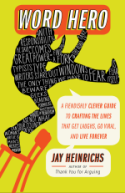
Oh, dear. You leave me no choice but to plug my next book, Word Hero, which contains many useful exercises to strengthen your rhetorical muscles. Check out WordHero.org.
Fig.
Thank you for writing this book, it was such an eye opener for me and meanwhile I’ve read it through multiple times!
Alas by reading alone you don’t improve your rethorical skills very much… how would you propose to practice all your wise lessons? Of course, daily & work life provide a wonderful arena, but I’m not much of a ‘talker’ and I should force myself to have some deliberate practice, so I was wondering if there exist any ‘debating clubs’ for my level?
I believe you find these easily in the USA, but where I live (Belgium) I don’t find anything. It even seems that ‘debating’ has been banned from cultural life (maybe it has been replaced by conceptual artists, which is a pity)…
Could you help me/give me some clues?
Thank you so much!
Dear Peter,
Oh, dear. You leave me no choice but to plug my next book, Word Hero, which contains many useful exercises to strengthen your rhetorical muscles. Check out WordHero.org.
Fig.
September 14, 2011 |
Pieter
Pieter
Hey Fig,
I'm a huge fan of Thank You for Arguing. I found that it has helped me so much at work (and at home) that I put together a slide deck on the book and have given presentations on the subject of Rhetoric multiple times to my coworkers (it has been received surprisingly well for a bunch of Engineers). HR has asked me to present some of this for the company at large but I thought it would be so much more interesting and impactful to have the man himself. So what do ya' say??
How does your October look? Can you give me a proposal for you to come up for a full-day or 1/2-day class? The class would be held in our offices in Anchorage, Alaska (don't worry, snow doesn't fly until right close to Halloween). I would love for you to include in the price the cost for each participant to receive a copy of your book (either TY for Arguing or your new one) because, by god, everyone should have a copy. Engineers so badly need the powers of persuasion and so poorly lack the skills. It would be a sin (rhetorically speaking) to forego the opportunity. Don't you think?
I should mention my rhetorical tool of choice for this interaction is persistence. Although not delineated so much in the book, it has its applications, and provided apporpriate use, can lead to success. That is to say, that a simple "no" will not suffice for a reply. I, by your advice, am committed to a world of positive manipulation...dissemenating the points as you have laid them out in your book is my mission, and you, kind sir, are the most effective way to achieve it.
Let's march!!
- Mike
Dear Mike,
I responded with lightning speed, plus nine days, by email. I have done workshops with NASA as its one and only consulting rhetorician, so would love to work with your engineers. Let's talkQ
I'm a huge fan of Thank You for Arguing. I found that it has helped me so much at work (and at home) that I put together a slide deck on the book and have given presentations on the subject of Rhetoric multiple times to my coworkers (it has been received surprisingly well for a bunch of Engineers). HR has asked me to present some of this for the company at large but I thought it would be so much more interesting and impactful to have the man himself. So what do ya' say??
How does your October look? Can you give me a proposal for you to come up for a full-day or 1/2-day class? The class would be held in our offices in Anchorage, Alaska (don't worry, snow doesn't fly until right close to Halloween). I would love for you to include in the price the cost for each participant to receive a copy of your book (either TY for Arguing or your new one) because, by god, everyone should have a copy. Engineers so badly need the powers of persuasion and so poorly lack the skills. It would be a sin (rhetorically speaking) to forego the opportunity. Don't you think?
I should mention my rhetorical tool of choice for this interaction is persistence. Although not delineated so much in the book, it has its applications, and provided apporpriate use, can lead to success. That is to say, that a simple "no" will not suffice for a reply. I, by your advice, am committed to a world of positive manipulation...dissemenating the points as you have laid them out in your book is my mission, and you, kind sir, are the most effective way to achieve it.
Let's march!!
- Mike
Dear Mike,
I responded with lightning speed, plus nine days, by email. I have done workshops with NASA as its one and only consulting rhetorician, so would love to work with your engineers. Let's talkQ
August 1, 2011 |
Mike Driscoll
Mike Driscoll
Hi Jay,
My name is Davin and I come from the land of Saints & Scholars. Magical mystical Ireland may be going through some hard times, but at least we are still rich in language. At least so I thought!
I picked up your book on Amazon a few weeks ago and I have to say what a fantastic read. Having worked in Advertising for many years, it appears from your rhetoric that I am more of a Judas than a Paddy. However and thanks to your book, I can now certainly persuade you that I am more of the latter rather than the former.
Nevertheless, I am hungry to learn more and I have already devoured your recommended reading list. The visual learner that I am, I was wondering if there are any DVD's on the subject? I can't seem to find any on the net and considering your professorial status on the subject, I am sure there is no better man to point me in the right direction.
If such a product does not exist, you should seriously consider producing one yourself. It is the ideal medium for generation X (the medium is the message) and when it comes to Ethos, you ooze credibility. Nevertheless, if any such products currently exist, I would be grateful if you could recommend them to me.
I look forward to your new book and many thanks for the advice
Davin Mac Ananey
Dublin, Ireland
Dear Davin,
I don't know of any DVDs worth the purchase. But go to WordHero.org, Figaro's sister site, for a couple of videos. Over the weeks to come, we'll be uploading "two-minute lectures" on rhetorical and figurative topics. Stay tuned!
Fig.
My name is Davin and I come from the land of Saints & Scholars. Magical mystical Ireland may be going through some hard times, but at least we are still rich in language. At least so I thought!
I picked up your book on Amazon a few weeks ago and I have to say what a fantastic read. Having worked in Advertising for many years, it appears from your rhetoric that I am more of a Judas than a Paddy. However and thanks to your book, I can now certainly persuade you that I am more of the latter rather than the former.
Nevertheless, I am hungry to learn more and I have already devoured your recommended reading list. The visual learner that I am, I was wondering if there are any DVD's on the subject? I can't seem to find any on the net and considering your professorial status on the subject, I am sure there is no better man to point me in the right direction.
If such a product does not exist, you should seriously consider producing one yourself. It is the ideal medium for generation X (the medium is the message) and when it comes to Ethos, you ooze credibility. Nevertheless, if any such products currently exist, I would be grateful if you could recommend them to me.
I look forward to your new book and many thanks for the advice
Davin Mac Ananey
Dublin, Ireland
Dear Davin,
I don't know of any DVDs worth the purchase. But go to WordHero.org, Figaro's sister site, for a couple of videos. Over the weeks to come, we'll be uploading "two-minute lectures" on rhetorical and figurative topics. Stay tuned!
Fig.
August 1, 2011 |
Davin
Davin
Just finished Thank You For Arguing. I loved it and will be continuing my study of Rhetoric immediately. I also intend on integrating it into my work and advocating for it at my alma maters! (What's the point of learning Latin and Greek and NOT studying Rhetoric?)
I do have a question? What is a good way to handle a rhetorical foul? namely blatant and utter stupidity. Is there a way to refocus or should I focus on landing a coup de grace upon my opponent at that point? I have been arguing quite effectively with people until they will say something utterly insipid (e.g. You may be right about the issue but you are still wrong!).
Thank you very much!
Prometheus
Smile and walk away. Your example isn't a foul so much as a gesture that your opponent is tired of arguing. That's assuming, of course, that the person you're trying to persuade is your opponent. If there's a larger, more persuadable audience, turn to them and ask their opinion. You'll at least appear to be the nicer guy.
Thanks for pushing my books and, more importantly, rhetoric at your institutions. Persuade them gently!
Fig.