
Ask Figaro
Got a question about rhetoric, figures, Figaro, Figaro's book,the nature of the universe, or just want to lavish praise?
Write in the form at the bottom of this page.
Dear Figaro,
Republicans (Akin and Angle) use the wordcombinations 'legitimate rape' and 'forcible rape'. What's your reaction?
Yours,
Arie Vrolijk
Republicans (Akin and Angle) use the wordcombinations 'legitimate rape' and 'forcible rape'. What's your reaction?
Yours,
Arie Vrolijk
August 24, 2012 |
 Arie Vrolijk
Arie Vrolijk
Dear Figaro,
I'm wondering if there's a rhetorical name for the (strategic) conflation of terms. I'll give you an example from my current project: I'm looking at the way we talk about "achievement" in regards to education, a word that is widely agreed to denote test scores and grades. In some cases, speakers or writers conflate "achievement" with "ability," which is used to describe something innate in a person, his or her capacity to learn. I want to point out that in some cases, this has not been an accident or a confusion but a strategic conflation of terms with a clear ideological agenda. I could just say "conflate" but I thought there might be another word for it. Is there?
This could be really helpful in this campaign season, as conflating disparate ideas strikes me as a favorite move in political rhetoric.
Thank you!
Laura
I'm wondering if there's a rhetorical name for the (strategic) conflation of terms. I'll give you an example from my current project: I'm looking at the way we talk about "achievement" in regards to education, a word that is widely agreed to denote test scores and grades. In some cases, speakers or writers conflate "achievement" with "ability," which is used to describe something innate in a person, his or her capacity to learn. I want to point out that in some cases, this has not been an accident or a confusion but a strategic conflation of terms with a clear ideological agenda. I could just say "conflate" but I thought there might be another word for it. Is there?
This could be really helpful in this campaign season, as conflating disparate ideas strikes me as a favorite move in political rhetoric.
Thank you!
Laura
August 11, 2012 |
Laura
Laura
Howdy Figaro-
What is your opinion on rhetoric vs. logic? I read a very interesting blog post recently [ http://charltonteaching.blogspot.com/2010/09/rhetoric-versus-logic.html ] that talks about how logic gained preeminence as a sort of truth standard, to which all other forms of study are subordinate, while rhetoric always remained secondary to truth, more like a way of pointing towards the truth. The implication I believe was that logic became almost inherently fascistic in a sense. Opinions?
Gabriel
Dear Gabriel,
What you're really talking about is the difference between rhetoric and what the Greek Sophists called "dialectic." Rhetoric seeks to persuade people into making a choice, feeling loyal toward a group or leader or brand, or convicting someone of a crime. Dialectic engages in dialogue to find the "truth."
It's very nice to subordinate every kind of conversation under King Logic. But people will go on trying to persuade each other. As logical old Aristotle himself put it, "sorry human nature" will employ emotions as well as logic.
Which isn't entirely bad. Most disagreements have nothing to do with truth or falsity. They have to do with choices. If every choice were a true/false question, we wouldn't need dialogue at all. Just the right manual.
Figaro is very much pro-dialectic. He loves the ancient dialogues. But when it comes to choosing candidates--or vacations for that matter--he prefers good ol' rhetoric.
For more on the distinction between philosophical logic and the rhetorical kind, see Thank You for Arguing.
Fig.
What is your opinion on rhetoric vs. logic? I read a very interesting blog post recently [ http://charltonteaching.blogspot.com/2010/09/rhetoric-versus-logic.html ] that talks about how logic gained preeminence as a sort of truth standard, to which all other forms of study are subordinate, while rhetoric always remained secondary to truth, more like a way of pointing towards the truth. The implication I believe was that logic became almost inherently fascistic in a sense. Opinions?
Gabriel
Dear Gabriel,
What you're really talking about is the difference between rhetoric and what the Greek Sophists called "dialectic." Rhetoric seeks to persuade people into making a choice, feeling loyal toward a group or leader or brand, or convicting someone of a crime. Dialectic engages in dialogue to find the "truth."
It's very nice to subordinate every kind of conversation under King Logic. But people will go on trying to persuade each other. As logical old Aristotle himself put it, "sorry human nature" will employ emotions as well as logic.
Which isn't entirely bad. Most disagreements have nothing to do with truth or falsity. They have to do with choices. If every choice were a true/false question, we wouldn't need dialogue at all. Just the right manual.
Figaro is very much pro-dialectic. He loves the ancient dialogues. But when it comes to choosing candidates--or vacations for that matter--he prefers good ol' rhetoric.
For more on the distinction between philosophical logic and the rhetorical kind, see Thank You for Arguing.
Fig.
July 1, 2012 |
Gabriel
Gabriel
Dear Figaro,
I have really enjoyed reading your two books. Any future release on audio tape?
Antoinette
Dear Antoinette,
I'm glad you asked! An audio CD of Thank You for Arguing is in production and already available for pre-order on Amazon. The release date is June 4. No word yet when Audible will get hold of it and bring it to a mobile device near you. We'll keep you posted.
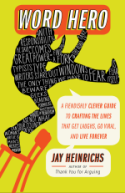
No audio of Word Hero is in the works yet. And for some mysterious reason, I major motion picture isn't being made. What's George Clooney doing? Sitting on his hands?
Fig.
I have really enjoyed reading your two books. Any future release on audio tape?
Antoinette
Dear Antoinette,
I'm glad you asked! An audio CD of Thank You for Arguing is in production and already available for pre-order on Amazon. The release date is June 4. No word yet when Audible will get hold of it and bring it to a mobile device near you. We'll keep you posted.
No audio of Word Hero is in the works yet. And for some mysterious reason, I major motion picture isn't being made. What's George Clooney doing? Sitting on his hands?
Fig.
May 23, 2012 |
Antoinette
Antoinette
Dear Figaro,
Great site! I love the posts. I'd like to get better at rhetoric/debate/writing. I've started both books Thank you for Arguing and Word Hero. Do you have any suggestions on college courses or further higher level education? Thanks!
Josh
Dear Josh,
Thanks for the kind words. Your best bet for rhetoric at college is at state universities such as Iowa State and Berkeley. Rhetoric education continues to grow at the public colleges, while it lags sadly behind in the elite private colleges. Go online and see what courses the schools offer. You may see courses and programs labeled "rhetoric" that actually have little to do with classical rhetoric. If the program doesn't offer courses with Aristotle, Cicero and Quintilian, don't apply. They're not the sum total of a rhetoric education, but you can't have an education in rhetoric without these foundational thinkers.
Oh, and avoid the Ivy League, which banished rhetoric many years ago and has yet to rediscover it. Does it seem strange that the most elite liberal arts schools fail to teach one of the original liberal arts? Does it seem weird that rhetoric, the art of leadership, remains missing even while Americans are questioning the expense and relevance of a liberal arts degree? It sure does to me.
Fig.
Great site! I love the posts. I'd like to get better at rhetoric/debate/writing. I've started both books Thank you for Arguing and Word Hero. Do you have any suggestions on college courses or further higher level education? Thanks!
Josh
Dear Josh,
Thanks for the kind words. Your best bet for rhetoric at college is at state universities such as Iowa State and Berkeley. Rhetoric education continues to grow at the public colleges, while it lags sadly behind in the elite private colleges. Go online and see what courses the schools offer. You may see courses and programs labeled "rhetoric" that actually have little to do with classical rhetoric. If the program doesn't offer courses with Aristotle, Cicero and Quintilian, don't apply. They're not the sum total of a rhetoric education, but you can't have an education in rhetoric without these foundational thinkers.
Oh, and avoid the Ivy League, which banished rhetoric many years ago and has yet to rediscover it. Does it seem strange that the most elite liberal arts schools fail to teach one of the original liberal arts? Does it seem weird that rhetoric, the art of leadership, remains missing even while Americans are questioning the expense and relevance of a liberal arts degree? It sure does to me.
Fig.
April 28, 2012 |
Josh
Josh
Dear Figaro,
I am in Composition 300 at Colorado State University. I need to know what your belief is about humor in blogs--specifically personal profiles, and in Argument papers. I believe that if your audience involves people and/or their kids, then showing that you can see the funny side of things makes people more likely to remember you and care what you say--without sacrificing clarity or ethos, of course. My composition professor doesn't seem to believe that, and I feel as if I am being unfairly discriminated against because I am trying to have a certain tone and creativity especially in my personal profile on the blog that we are required to have. What are your thoughts please? And do you have any advice in this matter? Thanks, Amie
Dear Amie,
I've been exploiting my family for humor for years. In this case, though, I side with your humorless prof.
Let's look at your problem this way. Would you wear the same clothing in class that you would in a Boulder nightclub? Maybe you would; I have no idea what people wear in Boulder nightclubs, or even whether Boulder has nightclubs. (Let me know--I'm going there in a month.)
In any case, we're talking decorum--what's the proper style for your audience. A blog is like a nightclub. (Figarospeech more like a really quiet bar, but bear with me.) An argument paper, on the other hand, is like speaking in front of the Supreme Court. A blog is informal. The Supreme Court is...well, just look at those people.
Writing style and clothing style both need to practice decorum, fitting in with the audience. And who determines that style? The audience. If your audience is your composition prof, and your composition prof thinks humor about your family is too informal, then he's right.
Fig.
I am in Composition 300 at Colorado State University. I need to know what your belief is about humor in blogs--specifically personal profiles, and in Argument papers. I believe that if your audience involves people and/or their kids, then showing that you can see the funny side of things makes people more likely to remember you and care what you say--without sacrificing clarity or ethos, of course. My composition professor doesn't seem to believe that, and I feel as if I am being unfairly discriminated against because I am trying to have a certain tone and creativity especially in my personal profile on the blog that we are required to have. What are your thoughts please? And do you have any advice in this matter? Thanks, Amie
Dear Amie,
I've been exploiting my family for humor for years. In this case, though, I side with your humorless prof.
Let's look at your problem this way. Would you wear the same clothing in class that you would in a Boulder nightclub? Maybe you would; I have no idea what people wear in Boulder nightclubs, or even whether Boulder has nightclubs. (Let me know--I'm going there in a month.)
In any case, we're talking decorum--what's the proper style for your audience. A blog is like a nightclub. (Figarospeech more like a really quiet bar, but bear with me.) An argument paper, on the other hand, is like speaking in front of the Supreme Court. A blog is informal. The Supreme Court is...well, just look at those people.
Writing style and clothing style both need to practice decorum, fitting in with the audience. And who determines that style? The audience. If your audience is your composition prof, and your composition prof thinks humor about your family is too informal, then he's right.
Fig.
April 13, 2012 |
Amie Conant
Amie Conant
First, your Word Hero is a god send. I have long been searching for tools that would help me craft my wit. And I have appreciated learning about the rhetorical forms, and can now see them in Advertising and Politics (tis the season), as well as in the words of Jesus (who knew!) The pith method is precisely how what I was trying to do without knowing it, and being able to do that, then chose a tool has made witing (portmanteau, im learning!!) one of the most enjoyable of activities.
Secondly, a query about "Getting Medieval". Are you familiar with the Smurfs? Is what they do when they replace words with "smurf" an example of Getting Medieval? Because that would make way more smurf to me than the term you used.
Thanks for such an invaluable resource!!
Darrel
Dear Darrel,
Frankly, Figaro doesn't watch the Smurfs. They make him feel blue.
But we're guessing that the creatures' word substitution constitutes a code language; call it "Smurf Latin." You know, like Igpay Atlinlay. "Getting Medieval" messes with syntax, by using an unusual part of speech as the object of a sentence--like "getting medieval on your ass." For more, see our sister site, http://Wordhero.org.
Fig.
Secondly, a query about "Getting Medieval". Are you familiar with the Smurfs? Is what they do when they replace words with "smurf" an example of Getting Medieval? Because that would make way more smurf to me than the term you used.
Thanks for such an invaluable resource!!
Darrel
Dear Darrel,
Frankly, Figaro doesn't watch the Smurfs. They make him feel blue.
But we're guessing that the creatures' word substitution constitutes a code language; call it "Smurf Latin." You know, like Igpay Atlinlay. "Getting Medieval" messes with syntax, by using an unusual part of speech as the object of a sentence--like "getting medieval on your ass." For more, see our sister site, http://Wordhero.org.
Fig.
March 10, 2012 |
Figaro
Figaro
I just started reading "Thank You for Arguing," and I'm very pleasantly surprised. I have never read a book on rhetoric before today and now I wish I had started learning about it years ago...
Many of the key issues in the first three chapters hit me like a club!
It all just clicked for me. Strangely, I had been thinking about much of what you wrote earlier today (before I'd even picked up your book). The practical, clear, and simple way that you explained "the difference between arguing and fighting," is liable to stick with me for the rest of my life, and may even play a key role in improving the success of many future relationships.
I'm afraid I have always been easily duped. When I see someone in need, I am the first one to show up and do anything I can to help them... I might as well have a target painted on my forehead!
In other words, I am a con-artists wet dream! (if I had any money that is)
I should get to the point, though, before I rant on too much... You seem very passionate about rhetoric, and I'd like to know how you most prefer to expand your knowledge in this area. Anything to get me pointed in the right direction after reading your books would be fantastic! :)
I don't fully expect a response, but hey, it was worth a try, right?! Thanks a million for your time,
Kirk
Dear Kirk,
Figaro doesn't have wet dreams. He has lucid dreams, in which he seduces bevies of young women into writing him bad checks. And in which smart people write flattering comments about his book.
You can start your rhetoric quest by reading the rest of Thank You for Arguing, of course. You'll find more recommended reading in the "Best Rhetoric Books" link on the top of this page.
Fig.
Many of the key issues in the first three chapters hit me like a club!
It all just clicked for me. Strangely, I had been thinking about much of what you wrote earlier today (before I'd even picked up your book). The practical, clear, and simple way that you explained "the difference between arguing and fighting," is liable to stick with me for the rest of my life, and may even play a key role in improving the success of many future relationships.
I'm afraid I have always been easily duped. When I see someone in need, I am the first one to show up and do anything I can to help them... I might as well have a target painted on my forehead!
In other words, I am a con-artists wet dream! (if I had any money that is)
I should get to the point, though, before I rant on too much... You seem very passionate about rhetoric, and I'd like to know how you most prefer to expand your knowledge in this area. Anything to get me pointed in the right direction after reading your books would be fantastic! :)
I don't fully expect a response, but hey, it was worth a try, right?! Thanks a million for your time,
Kirk
Dear Kirk,
Figaro doesn't have wet dreams. He has lucid dreams, in which he seduces bevies of young women into writing him bad checks. And in which smart people write flattering comments about his book.
You can start your rhetoric quest by reading the rest of Thank You for Arguing, of course. You'll find more recommended reading in the "Best Rhetoric Books" link on the top of this page.
Fig.
March 10, 2012 |
Figaro
Figaro
Dear Figaro,
I saw this note on a high school student's locker: "Caution: Blonde trapped in a brunette's body."
What would you call this? This is the one where a part stands for the whole, right? Is that synecdoche?
Michael
Dear Michael,
Close but no metaphorical cigar! That blonde is a metonymy, which transfers one trait onto another. A synecdoche swaps the part for the whole, while a metonymy takes a characteristic and makes it represent the thing it characterizes. Tricky stuff, I know. To learn more, go to our sister site and read this extremely short detective story: http://www.wordhero.org/story.
Fig.
I saw this note on a high school student's locker: "Caution: Blonde trapped in a brunette's body."
What would you call this? This is the one where a part stands for the whole, right? Is that synecdoche?
Michael
Dear Michael,
Close but no metaphorical cigar! That blonde is a metonymy, which transfers one trait onto another. A synecdoche swaps the part for the whole, while a metonymy takes a characteristic and makes it represent the thing it characterizes. Tricky stuff, I know. To learn more, go to our sister site and read this extremely short detective story: http://www.wordhero.org/story.
Fig.
March 9, 2012 |
Michael
Michael
Hi, there, Figaro!
What do you call it when you are with a group of people who are talking about a subject then you decide to talk about something else altogether different? It's not quite like changing the subject because in my head it's so obviously connected. Like if people are talking about politics and Newt Gingrich and i bring up the movie "Aliens" because in my head the connection is that in the movie aliens, there was also someone named Newt.
Jamo
Dear Jamo,
The name for an irrelevant topic is non sequitur, Latin for "It does not follow." Non sequiturs often do follow obscurely, though, branching off on young topical sprouts. If the others can follow you, fine. After all, conversations tend to have more to do with maintaining bonds than with the advancement of knowledge.
And speaking of Bonds, are you as unenamored of Daniel Craig as I am?
Fig.
What do you call it when you are with a group of people who are talking about a subject then you decide to talk about something else altogether different? It's not quite like changing the subject because in my head it's so obviously connected. Like if people are talking about politics and Newt Gingrich and i bring up the movie "Aliens" because in my head the connection is that in the movie aliens, there was also someone named Newt.
Jamo
Dear Jamo,
The name for an irrelevant topic is non sequitur, Latin for "It does not follow." Non sequiturs often do follow obscurely, though, branching off on young topical sprouts. If the others can follow you, fine. After all, conversations tend to have more to do with maintaining bonds than with the advancement of knowledge.
And speaking of Bonds, are you as unenamored of Daniel Craig as I am?
Fig.
March 9, 2012 |
Jamo
Jamo
Dear Figaro,
Do you think that Dickens invented the term 'circumlocution?"
Or did current (beaurocratic) conditions in Britain at that time give the term common use, thus plugges in to "Little Dorritt"? Thanx..gg
Dear gg,
Dickens certainly didn't invent the term; it's been in English usage since well before Shakespeare. But Dickens was the first to refer to government as "Circumlocution." He meant it satirically. You know, like Office of Runaround. Today, we call that the DMV.
Fig.
Do you think that Dickens invented the term 'circumlocution?"
Or did current (beaurocratic) conditions in Britain at that time give the term common use, thus plugges in to "Little Dorritt"? Thanx..gg
Dear gg,
Dickens certainly didn't invent the term; it's been in English usage since well before Shakespeare. But Dickens was the first to refer to government as "Circumlocution." He meant it satirically. You know, like Office of Runaround. Today, we call that the DMV.
Fig.
February 13, 2012 |
gg
gg
Dear Figaro,
I am currently reading "Thank you for Arguing" and "Word Hero" (which are great books for a philosophy major and aspiring lawyer that loves to argue!) and I would appreciate your advice.
I am going to write a letter to a potential employer soon with the hope of getting a job interview at the company's headquarters. I was previously given a very brief preliminary interview on my college campus (I am a senior) in November but the man who interviewed me did not select me to go to the next round of interviews. He said I was likeable, intelligent, and ethical but he said I wasn't aggressive enough and that I didn't give off an aura of being in charge. I agree these are important traits for this job (district manager) but I know he was wrong about me. I am aggressive and I would act like I was in charge if I was actually in charge. I want a chance to be more thoroughly interviewed so I can prove that I am a good candidate.
I plan to write a letter to the vice president of the division (the man who interviewed me would be my direct supervisor if I got hired but the VP actually makes the final hiring decisions for DMs--I never had a chance to meet the VP) to ask him to reconsider his decision not to interview me further. I really want this job and I feel it is right for me. I have many arguments to present in my favor but I want the letter to be brief so that he will read it. How can I convince him to take interest in me as a candidate?
I think it may be a good idea to argue that the company would benefit with me as a district manager and I want to convey that I am aggressive, perhaps using anecdotal evidence. What do you think? I appreciate your help. Thanks!
Bill
Dear Bill,
Try this for aggression: Call the VP and tell him to fire your interviewer.
On second thought, you probably shouldn't call at all. Generally, when an interviewer describes desirable personality traits, he's really just describing himself. Translation: "The trouble with you, son, is that you're not enough like me."
So you plan to be a district manager before going to law school? Maybe your interviewer picked up on your real future career path. Does the job involve sales? In which case, aggression can help sometimes. Or is it district manager of the local Mafia? Aggression would definitely help there. But we've been managing people for more than 30 years, and generally find that aggression isn't a desirable management trait. Nor do we believe your interviewer thinks so, either.
There's a rhetorical lesson here. What a person says isn't always what he means. You knew that, of course. And if you were truly aggressive, you'd tell us what a jerk we are for telling you what you already know.
Meanwhile, move on.
Fig.
Dear Figaro,
One of my problems with the interviewer's feedback is that he was not at all aggressive during the interview yet he somehow got promoted to the director level role after just four years as a DM. During the interview, he was really likeable and nice--kind of like me. My argument is that he is a nice guy that isn't aggressive 24/7 and he did great as a DM. In my social philosophy textbook today, this caught my eye: “When interviewing a job candidate, we tend to explain what the person says or does in light of the dispositions we (overconfidently) impute to him or her, rather than to the special nature of the interview situation.” I think this describes exactly what I fell victim to.
I agree that aggression is not the best trait for a DM. In fact, in a draft of a letter to the VP, I quoted a paragraph from "Thank You For Arguing" where you explain how the power of persuasion, rather than aggressiveness, is essential to being a good leader.
I think being a good lawyer requires many of the same skills that being a good DM requires. I would like to be a lawyer but going to law school isn't a wise economic decision these days and, with my dismal LSAT score, I won't get good scholarships at T2 law schools. (by the way, he had no way of knowing that going to law school was goal should I fail to get the DM job). I would much rather start a career right away earning $70,000 the first year and $95,000 by the fourth year with the privilege of using an expenses paid company car. All while living at home with my parents and thus having the opportunity to save almost all of my earnings.
I clearly don't want to "move on" just yet. Why? Because, quite ironically, I'm aggressive. Do you have any advice for writing a letter to the VP? I know it is a long shot but I would really like to be successful at this. It would make for a great story of how persistence and good argumentation rhetoric can get you what you want.
Bill
Dear Bill,
Keep in mind that there's probably more than one candidate for the job. It's not necessarily that you're unqualified; it's that someone else seems a better fit. Go ahead and write the VP. Say how passionate you are about the company, and how you think it's perfect for you. Say specifically what you can do. Follow my advice in Thank You for Arguing in structuring your pitch--in fact, the outline to a Ciceronian oration would work perfectly: exhortation, narration, proof, division, peroration. All in a single paragraph!
And conclude by asking to be considered if something else opens up.
Fig.
I am currently reading "Thank you for Arguing" and "Word Hero" (which are great books for a philosophy major and aspiring lawyer that loves to argue!) and I would appreciate your advice.
I am going to write a letter to a potential employer soon with the hope of getting a job interview at the company's headquarters. I was previously given a very brief preliminary interview on my college campus (I am a senior) in November but the man who interviewed me did not select me to go to the next round of interviews. He said I was likeable, intelligent, and ethical but he said I wasn't aggressive enough and that I didn't give off an aura of being in charge. I agree these are important traits for this job (district manager) but I know he was wrong about me. I am aggressive and I would act like I was in charge if I was actually in charge. I want a chance to be more thoroughly interviewed so I can prove that I am a good candidate.
I plan to write a letter to the vice president of the division (the man who interviewed me would be my direct supervisor if I got hired but the VP actually makes the final hiring decisions for DMs--I never had a chance to meet the VP) to ask him to reconsider his decision not to interview me further. I really want this job and I feel it is right for me. I have many arguments to present in my favor but I want the letter to be brief so that he will read it. How can I convince him to take interest in me as a candidate?
I think it may be a good idea to argue that the company would benefit with me as a district manager and I want to convey that I am aggressive, perhaps using anecdotal evidence. What do you think? I appreciate your help. Thanks!
Bill
Dear Bill,
Try this for aggression: Call the VP and tell him to fire your interviewer.
On second thought, you probably shouldn't call at all. Generally, when an interviewer describes desirable personality traits, he's really just describing himself. Translation: "The trouble with you, son, is that you're not enough like me."
So you plan to be a district manager before going to law school? Maybe your interviewer picked up on your real future career path. Does the job involve sales? In which case, aggression can help sometimes. Or is it district manager of the local Mafia? Aggression would definitely help there. But we've been managing people for more than 30 years, and generally find that aggression isn't a desirable management trait. Nor do we believe your interviewer thinks so, either.
There's a rhetorical lesson here. What a person says isn't always what he means. You knew that, of course. And if you were truly aggressive, you'd tell us what a jerk we are for telling you what you already know.
Meanwhile, move on.
Fig.
Dear Figaro,
One of my problems with the interviewer's feedback is that he was not at all aggressive during the interview yet he somehow got promoted to the director level role after just four years as a DM. During the interview, he was really likeable and nice--kind of like me. My argument is that he is a nice guy that isn't aggressive 24/7 and he did great as a DM. In my social philosophy textbook today, this caught my eye: “When interviewing a job candidate, we tend to explain what the person says or does in light of the dispositions we (overconfidently) impute to him or her, rather than to the special nature of the interview situation.” I think this describes exactly what I fell victim to.
I agree that aggression is not the best trait for a DM. In fact, in a draft of a letter to the VP, I quoted a paragraph from "Thank You For Arguing" where you explain how the power of persuasion, rather than aggressiveness, is essential to being a good leader.
I think being a good lawyer requires many of the same skills that being a good DM requires. I would like to be a lawyer but going to law school isn't a wise economic decision these days and, with my dismal LSAT score, I won't get good scholarships at T2 law schools. (by the way, he had no way of knowing that going to law school was goal should I fail to get the DM job). I would much rather start a career right away earning $70,000 the first year and $95,000 by the fourth year with the privilege of using an expenses paid company car. All while living at home with my parents and thus having the opportunity to save almost all of my earnings.
I clearly don't want to "move on" just yet. Why? Because, quite ironically, I'm aggressive. Do you have any advice for writing a letter to the VP? I know it is a long shot but I would really like to be successful at this. It would make for a great story of how persistence and good argumentation rhetoric can get you what you want.
Bill
Dear Bill,
Keep in mind that there's probably more than one candidate for the job. It's not necessarily that you're unqualified; it's that someone else seems a better fit. Go ahead and write the VP. Say how passionate you are about the company, and how you think it's perfect for you. Say specifically what you can do. Follow my advice in Thank You for Arguing in structuring your pitch--in fact, the outline to a Ciceronian oration would work perfectly: exhortation, narration, proof, division, peroration. All in a single paragraph!
And conclude by asking to be considered if something else opens up.
Fig.
February 13, 2012 |
Bill
Bill
Firstly, I'm big fan of both your books, and this blog. Keep up the great work!
I am going to be leading a rather in depth review of an agency in a few days. I have been on many of these throughout the years, but I have never led one. During this process, I have to speak to both my team members and the agency we are examining.
Hypothetically, say I am corrected by a team members because I forget to mention something, or I leave something out of the entrance interview. What are some prosaic ways of going about correcting myself, thanking my team member for his/her insight and still come off as the "boss" while not skipping a beat?
Thank you!
Mickey
Dear Mickey,
I can tell you're already a star: you want to use your mistakes to your advantage. I love those moments when I can prove my Ethos in front of an audience. When a team member corrects you, brag about what a good recruiter you are. Or say, "A good manager always hires people smarter than he is. Proof positive, right here." That kind of false modesty tends to get a chuckle while showing your smooth leadership skills.
Let me know how it works out.
Fig.
Mickey
I am going to be leading a rather in depth review of an agency in a few days. I have been on many of these throughout the years, but I have never led one. During this process, I have to speak to both my team members and the agency we are examining.
Hypothetically, say I am corrected by a team members because I forget to mention something, or I leave something out of the entrance interview. What are some prosaic ways of going about correcting myself, thanking my team member for his/her insight and still come off as the "boss" while not skipping a beat?
Thank you!
Mickey
Dear Mickey,
I can tell you're already a star: you want to use your mistakes to your advantage. I love those moments when I can prove my Ethos in front of an audience. When a team member corrects you, brag about what a good recruiter you are. Or say, "A good manager always hires people smarter than he is. Proof positive, right here." That kind of false modesty tends to get a chuckle while showing your smooth leadership skills.
Let me know how it works out.
Fig.
Mickey
January 31, 2012 |
Mickey
Mickey
I was scanning through 'memes' the other day and one caught my attention at http://www.quickmeme.com/Karate-Kyle/
The question is: is there a name for the figure used by 'Karate Kyle' eg. 'They laughed at me in physical education. I laughed at them in physical therapy ' Seems to be some kind of parallelism but I can't pinpoint it.
Thanks!
Ed
Dear Ed,
I love a Figarist who scans memes, those little web-trend molecules. Your memester example is using two figures: the MESODIPLOSIS ("middle doubling"), which repeats a word or words in the middle of succeeding clauses; and a SYNCRISIS ("compare with" or "conclude with"), which compares or contrasts in two similar clauses. You'll see the syncrisis a lot in politics. Especially around now.
Fig.
The question is: is there a name for the figure used by 'Karate Kyle' eg. 'They laughed at me in physical education. I laughed at them in physical therapy ' Seems to be some kind of parallelism but I can't pinpoint it.
Thanks!
Ed
Dear Ed,
I love a Figarist who scans memes, those little web-trend molecules. Your memester example is using two figures: the MESODIPLOSIS ("middle doubling"), which repeats a word or words in the middle of succeeding clauses; and a SYNCRISIS ("compare with" or "conclude with"), which compares or contrasts in two similar clauses. You'll see the syncrisis a lot in politics. Especially around now.
Fig.
January 17, 2012 |
Figaro
Figaro
Dear Figaro,
People like to say things like "Ted and I talked about this earlier today. Now I think..."
What is the name of the strategy when someone casually mentions talking about something earlier--as if talking about something with someone else earlier adds some credibility to whatever is about to be said?
Chris
Dear Chris,
Aristotle would call good ol' Ted a "witness." As you surmised, having rhetorical backup assures your audience that you haven't spent the week brooding alone in your cabin.
Which, come to think of it, Figaro just did.
Fig.
People like to say things like "Ted and I talked about this earlier today. Now I think..."
What is the name of the strategy when someone casually mentions talking about something earlier--as if talking about something with someone else earlier adds some credibility to whatever is about to be said?
Chris
Dear Chris,
Aristotle would call good ol' Ted a "witness." As you surmised, having rhetorical backup assures your audience that you haven't spent the week brooding alone in your cabin.
Which, come to think of it, Figaro just did.
Fig.
January 17, 2012 |
Figaro
Figaro
Dear Jay,
I recently finish reading your book "Thank You for arguing" and I was mulling whether you will create a post about how to efficiently write an ethos resume.
Cheers,
Henry
I recently finish reading your book "Thank You for arguing" and I was mulling whether you will create a post about how to efficiently write an ethos resume.
Cheers,
Henry
January 16, 2012 |
Henry
Henry
Dear Jay,
I'm a recent MBA graduate from the University of Cambridge in the UK. I'd like to invite you to be an early reviewer of Doodleslide, a new plugin I've designed for PowerPoint that makes creating amazing presentations easy.
View Doodleslide's website: http://doodleslide.com
I created the plugin late last year, it has been designed to end the dreaded "Death by PowerPoint".
It is really easy to use - two buttons are added to your PowerPoint ribbon that let you insert awesome doodles and slide templates in seconds.
There's over 300 doodle images in over twenty categories that have been custom created for presentations.
There are also template slides - I think you'll find these particularly impressive. In just a few clicks you can insert these appealing slides that are ready for you to add your text content. I have designed templates specifically for education and business usage.
Being a recent MBA graduate, I couldn't help but also include some business-relevant templates including stunning templates.
The plugin has already received positive reviews and testimonials:
http://doodleslide.com/hand-drawn-powerpoint-doodle-images-testimonials/
I'd be keen to hear your thoughts about the plugin!
I thought that I might offer you a copy for free (it normally sells for $49.95). So I've created a 'coupon code' so that you can download the plugin without entering payment info.
Your coupon code is "DDL314"
To download Doodleslide:
1) Go to http://doodleslide.com
2) Click 'Get it now'
3) Then click "Enter coupon code" and enter your code (without quotation marks).
It won't ask you for payment details.
You will then be emailed a download link for the plugin.
Sadly I haven't yet built Office for Mac support into the Doodleslide plugin. If there is sufficient demand, I will get working on that! It does, however, work on all versions of Office for PC from Office 2003 onwards.
The story behind the plugin: I was sitting in a lecture whilst doing my MBA during early 2011 at the University of Cambridge and got a little frustrated with the nature of the lecturer's PowerPoints. I started drawing pictures on my notepad that represented the ideas that the professor was discussing.
Some friends saw these pictures ('doodles') and asked if they could have copies. It turned out that the pictures were easier to understand and learn from than the lecturer's PowerPoint slides. And so I decided to see if I could make use of these pictures to make PowerPoint presentations more appealing and exciting.
I've put more info on the background of the doodleslide project here:
http://doodleslide.com/hand-drawn-powerpoint-doodle-images-about/
Would love to hear your thoughts and look forward to your review!
All the very best,
Gavin Wedell
London, UK.
gavin.wedell@doodleslide.com
m: +44-7549-919-147
http://doodleslide.com
www.gavinwedell.com
I'm a recent MBA graduate from the University of Cambridge in the UK. I'd like to invite you to be an early reviewer of Doodleslide, a new plugin I've designed for PowerPoint that makes creating amazing presentations easy.
View Doodleslide's website: http://doodleslide.com
I created the plugin late last year, it has been designed to end the dreaded "Death by PowerPoint".
It is really easy to use - two buttons are added to your PowerPoint ribbon that let you insert awesome doodles and slide templates in seconds.
There's over 300 doodle images in over twenty categories that have been custom created for presentations.
There are also template slides - I think you'll find these particularly impressive. In just a few clicks you can insert these appealing slides that are ready for you to add your text content. I have designed templates specifically for education and business usage.
Being a recent MBA graduate, I couldn't help but also include some business-relevant templates including stunning templates.
The plugin has already received positive reviews and testimonials:
http://doodleslide.com/hand-drawn-powerpoint-doodle-images-testimonials/
I'd be keen to hear your thoughts about the plugin!
I thought that I might offer you a copy for free (it normally sells for $49.95). So I've created a 'coupon code' so that you can download the plugin without entering payment info.
Your coupon code is "DDL314"
To download Doodleslide:
1) Go to http://doodleslide.com
2) Click 'Get it now'
3) Then click "Enter coupon code" and enter your code (without quotation marks).
It won't ask you for payment details.
You will then be emailed a download link for the plugin.
Sadly I haven't yet built Office for Mac support into the Doodleslide plugin. If there is sufficient demand, I will get working on that! It does, however, work on all versions of Office for PC from Office 2003 onwards.
The story behind the plugin: I was sitting in a lecture whilst doing my MBA during early 2011 at the University of Cambridge and got a little frustrated with the nature of the lecturer's PowerPoints. I started drawing pictures on my notepad that represented the ideas that the professor was discussing.
Some friends saw these pictures ('doodles') and asked if they could have copies. It turned out that the pictures were easier to understand and learn from than the lecturer's PowerPoint slides. And so I decided to see if I could make use of these pictures to make PowerPoint presentations more appealing and exciting.
I've put more info on the background of the doodleslide project here:
http://doodleslide.com/hand-drawn-powerpoint-doodle-images-about/
Would love to hear your thoughts and look forward to your review!
All the very best,
Gavin Wedell
London, UK.
gavin.wedell@doodleslide.com
m: +44-7549-919-147
http://doodleslide.com
www.gavinwedell.com
January 12, 2012 |
Gavin Wedell
Gavin Wedell
Figaro,
In "Thank You for Arguing" on page 239, you discussed the five senses and their relation to ethos, pathos, and logos. I wondered if you could direct me to further work on this subject. I have had a difficult find digging up more information on this particular topic, and your presentation of it has intrigued me.
Thank you!
Dear Andrew,
You'll find references to the senses' logical and pathetic natures in Aristotle's Rhetoric; but for the most part the speculating is all mine (Jay Heinrichs's, I mean). The parts about various media serving the cause of Kairos are also mine.
Fig.
In "Thank You for Arguing" on page 239, you discussed the five senses and their relation to ethos, pathos, and logos. I wondered if you could direct me to further work on this subject. I have had a difficult find digging up more information on this particular topic, and your presentation of it has intrigued me.
Thank you!
Dear Andrew,
You'll find references to the senses' logical and pathetic natures in Aristotle's Rhetoric; but for the most part the speculating is all mine (Jay Heinrichs's, I mean). The parts about various media serving the cause of Kairos are also mine.
Fig.
January 5, 2012 |
Andrew
Andrew
Figaro,
In "Thank you for Arguing" you mentioned that are rhetorical forefathers kept a note book for recording common places. I am struggling a little on how to do this. It seems I might be writing everything down as a common place. Would you give me a little guidance on how to be best to identify "common place" worhy for note?
ALR
Dear ALR,
Look up the diaries of most of the American founders--particularly Thomas Jefferson--and you'll find a treasure trove of commonplaces.
Fig.
In "Thank you for Arguing" you mentioned that are rhetorical forefathers kept a note book for recording common places. I am struggling a little on how to do this. It seems I might be writing everything down as a common place. Would you give me a little guidance on how to be best to identify "common place" worhy for note?
ALR
Dear ALR,
Look up the diaries of most of the American founders--particularly Thomas Jefferson--and you'll find a treasure trove of commonplaces.
Fig.
December 25, 2011 |
ALR
ALR
I enjoyed your post regarding the crafting of a 'winning college essay'. I agree with all the points you mention; however, I am in need of some advice regarding the following prompt used by many colleges & universities:
- Why X university?
Usually, the only stipulation is that the response be short (250 words or so). How does a student go about writing a 'winning college short answer response' to the above prompt?
Your knowledge, wisdom, and advice would be most appreciated.
Sincerely,
Ken